ChatGPT-Assisted Hacking: Pentesting Roku Apps for Fun and Profit
This article is based on a talk by Aakash Kharade (Security Team Lead at Accorian) at BSides Mumbai 2024. You can watch the full session on YouTube.
Almost every screen in our homes is online now. From our phones to our fridges, everything is "smart," and one of the easiest ways to upgrade an old TV is a little streaming stick like a Roku. These gadgets are handy, but each new app and channel we add also opens a new door for attackers. It can feel unsettling to picture someone poking at your television, yet learning how these systems work is the first real step toward keeping them safe.
That is exactly the spot security consultant Aakash Kharade found himself in when a Roku channel landed on his desk for testing. Roku was new to him, the code used a language he had not touched, and a client was waiting on results. His answer was to lean on ChatGPT-assisted hacking to learn fast and pentest Roku apps for fun and profit. His BSides Mumbai 2024 talk is a grounded look at how a modern tester breaks down a device most of us only use to watch shows, and it lands whether you are a student, a developer, or a seasoned security pro.
Key Takeaways
- An AI assistant like ChatGPT can be a strong research partner for unfamiliar technology, helping you learn a platform quickly, but it is not a magic shortcut and has clear limits.
- Streaming devices have a wider attack surface than people expect, including custom channels, backend traffic, debug logs, and stored secrets.
- The most serious findings were simple mistakes, like broken access controls and passwords sitting in debug logs, proving that the basics still matter most.
What Is a Roku, and Why Test It?
You have probably used a Roku or something like it. It plugs into your TV and turns it into a smart TV, letting you stream music, sports, and all kinds of channels, much like an Amazon Fire Stick. There are several models, from the older Roku Express, which was the one tested here, to the newer Roku Streaming Stick 4K. Each model runs its own firmware, so the details shift from device to device.
When a tester approaches Roku security testing, they map the full attack surface. That includes the network side, where you can scan the address the device picks up on your Wi-Fi. It also covers the firmware, the channels or apps themselves, and how the device stores data. A key question is whether secret keys are saved as plain text anyone could read, or locked away with encryption. This is not only a big-company concern. It reaches the person on the sofa, because a weak app can expose their accounts and personal details.
Inside a Custom Roku Channel: BrightScript and Developer Mode
Most people only see the public channels in Roku's store. But Roku also has a developer mode that lets people build private channels and share them with friends or coworkers. These never appear in the public store, which is exactly why organizations use them internally. In this case, the client handed over their own custom channel to test.
Building one takes Roku's development kit and a language called BrightScript, which Roku created itself, paired with a layout format called SceneGraph XML. A channel ships as a zip file. Aakash opened it in the Eclipse editor, found the main code file inside, and made his changes. Here he hit a snag many testers would recognize. Zipping the folder the normal way did not work, and it took some digging to learn that a special plugin was needed to package and upload the changes. To load the channel, he switched on developer mode using a button sequence on the remote, which then showed an address he could open in a browser to upload his own version of the channel.
Setting Up to Intercept the Traffic
For most security tests, the first real goal is to see the traffic moving between the app and its backend servers. Testers usually capture this with a proxy tool, and Burp Suite is a common pick. But you cannot just plug a Roku into a laptop and read its traffic. Instead, Aakash set up a fake Wi-Fi access point and pointed the channel's backend address to his own machine, forcing the device's data to pass through him first.
There was one catch. The custom channel was checking the security certificate on its connections, so he had to add his own trusted certificate into the channel's code before the traffic would flow cleanly. As he pointed out, if a channel skips that check, a tester can skip that step too. Once it worked, the payoff was large. Reading and changing the backend requests opened the door to API security testing and the kinds of common web weaknesses found in the OWASP Top 10.
What the Pentest Uncovered: Broken Access Controls and Leaks
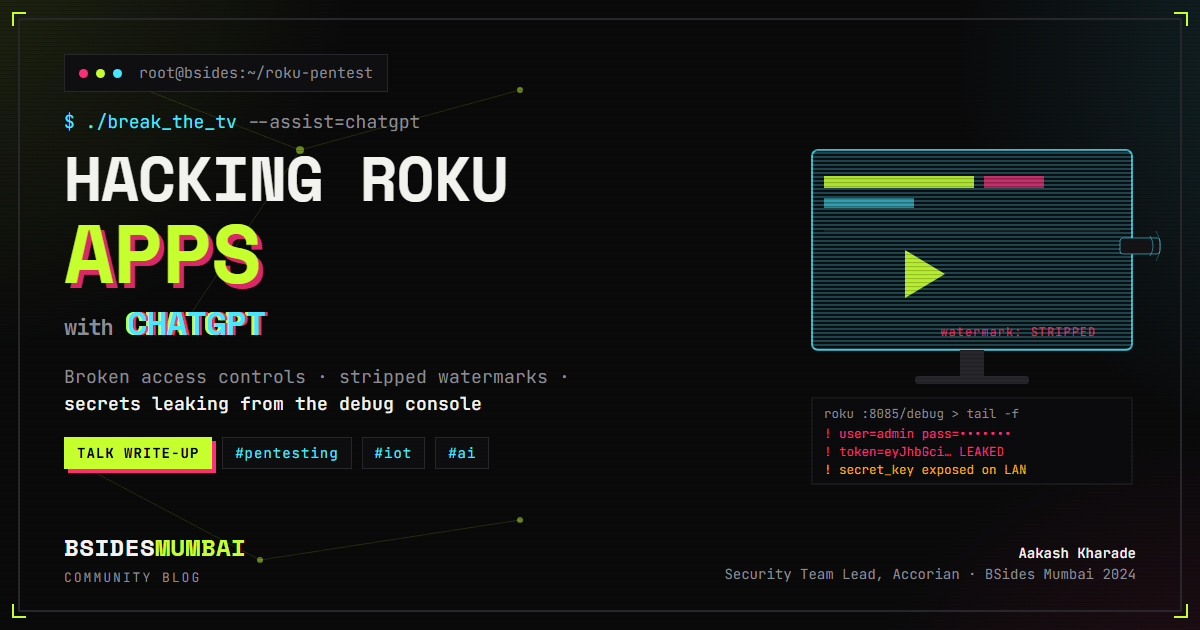
With traffic in hand, the findings arrived quickly, and many were broken access control issues. One clear example was a user who could still watch videos even after their subscription had ended, because the app never properly checked their status. That is the kind of gap that quietly drains a business.
The client also asked him to try defeating a watermark on their videos. This turned out to be simple. Because the watermark was added through the app's request rather than burned into the video itself, it could be stripped out, which meant a stream could be copied or recorded. That was the client's main worry, and the test showed the risk was real.
Then there was the debug console, a logging service Roku exposes over the network on port 8085. What it records depends on how the developer built the channel, and in this case it was leaking things that should never appear there: a username and password, an active login token, and a secret key. If an attacker sat on the same Wi-Fi as the TV, they could read it. Finding that was a sharp reminder to watch what your code writes down.
Where ChatGPT Helped, and Where It Hit a Wall
The honest part of this story is what makes it worth sharing. ChatGPT was a great teacher for the basics, quickly explaining what Roku was and how its channels could be examined. When Aakash wanted to open a command shell on the device, he searched the usual sources and came up empty. After reframing his prompt to explain that he was the developer, the AI produced code to try.
This is where reality set in. The shell code threw errors and would not run, because the aging Roku Express was simply too old to support it. He also looked into jailbreaking the device, which was not possible on that old model, though researchers have shown it can work on newer ones. In short, the AI gave him solid leads, but the hardware had the final say. That balance, real help paired with real limits, is the most useful takeaway for anyone using AI in security work.
Frequently Asked Questions
Is it legal to hack a Roku app like this?
This was authorized penetration testing, meaning the client hired the tester and gave permission to probe their own channel. Testing devices or apps you do not own, or without clear approval, is a different matter and can be illegal. Always get written permission first.
What is BrightScript?
BrightScript is the programming language Roku created for building channels on its platform. It works alongside SceneGraph XML, which handles the visual layout, while BrightScript handles the logic behind the app.
Can ChatGPT really help with security testing?
Yes, as a research and learning aid. It can explain unfamiliar systems, suggest approaches, and draft code to try. Just remember it can be wrong and cannot replace hands-on skill. Treat it as a helpful assistant, not the expert in the room.
What was the most serious issue found?
The broken access controls and the leaked secrets in the debug console stand out. Letting people watch paid content for free hurts revenue, and exposing passwords, tokens, and keys in logs can open the door to much larger attacks.
Summary
Good security work is often about curiosity and patience, not just fancy tools. By pairing ChatGPT-assisted hacking with careful hands-on testing, Aakash was able to pentest Roku apps for fun and profit, surfacing broken access controls, a weak watermark, and secrets leaking into logs. AI helped him learn a new platform fast, but the device's limits showed that human judgment still leads. Whether you are a student getting started or a working tester, the lesson holds: the basics, done well, catch the biggest problems, even on the little box hooked up to your TV.
About the Speaker
Aakash Kharade is a Security Team Lead at Accorian with several years of experience in the security field. He shared this Roku research at BSides Mumbai 2024 and enjoys making hands-on security testing approachable for others. You can connect with him on LinkedIn.
Watch the Full Talk
Want the complete walkthrough, including the live demo and the code he tried? Watch the full BSides Mumbai 2024 session below.