Mastering Your Cybersecurity Career: Skills, Networking & the Fresher Job Hunt
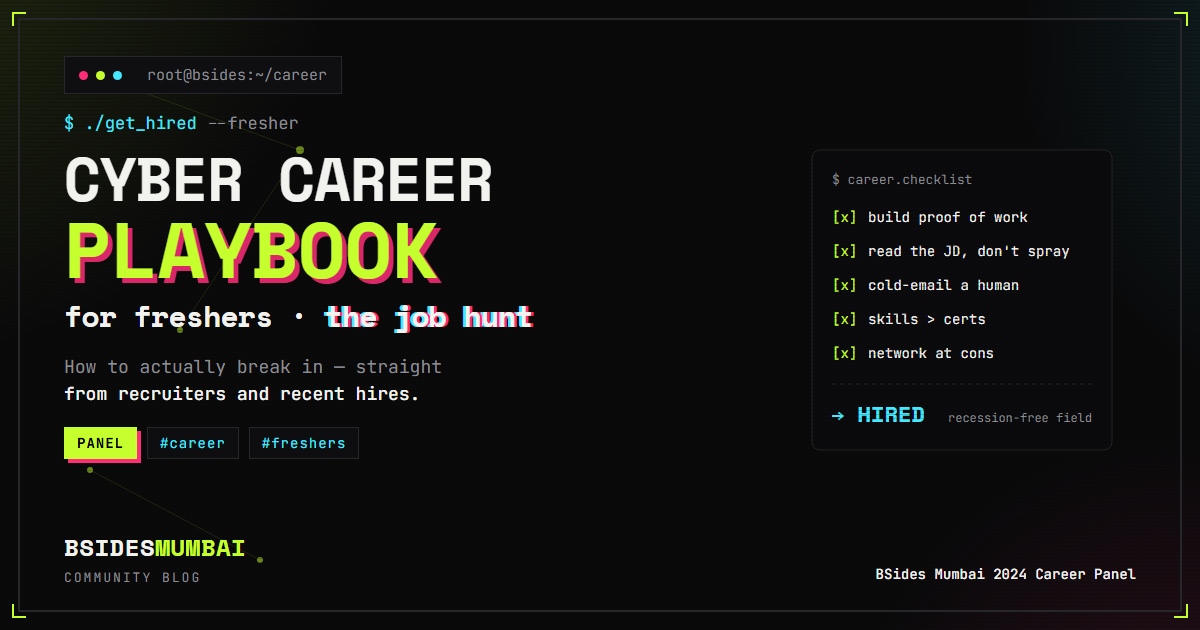
This article is based on the career panel "Mastering Your Cybersecurity Career: Skills, Networking, and Navigating the Job Hunt for Freshers" at BSides Mumbai 2024 - featuring trainers, startup founders, working recruiters, and recent graduates. You can watch the full session on YouTube.
The panel opened with a live demographic check that quietly demolished the "there are no jobs" narrative. In a room full of people, only about eight were looking for jobs - and roughly ten were actively hiring. Yet the same crowd scrolls LinkedIn every day reading that the market is dead. The moderator's challenge landed hard: you paid to attend a conference where people were literally offering jobs, and most of you never walked over to talk to them. The whole session was really about closing that gap - between the skills employers want and the way job-seekers actually present themselves.
Key Takeaways
- The shortage isn't really a shortage of jobs - it's a gap in networking and self-presentation. More people were hiring in the room than looking, and the two sides weren't talking.
- Proof of work beats a polished CV. Blogs, GitHub, CTF write-ups, and public research are what make a fresher stand out from a stack of 500 near-identical resumes.
- For beginners, skills beat certifications. Certs matter later (specialisation, promotions, pay bands) - not as the price of entry.
The Paradox in the Room
Recruiters described the reality from their side. Post one role on LinkedIn and you can get 500 CVs in an hour. A basic filter - a couple of years of experience, one required skill - cuts that to ~25-30. Then you actually talk to people, and many have exaggerated their CVs to the point that they can't explain how the internet works. Meanwhile roles sit open for months. The panel's point wasn't that candidates are hopeless; it's that the signal-to-noise ratio is brutal, and almost nobody does the small things that cut through it.
What Actually Gets You Noticed
The advice converged on a handful of concrete moves:
- Build public proof of work. Write articles, play CTFs, publish research, put projects on GitHub. It won't guarantee a job, but it turns you from a line in a CV stack into "this person is clearly active and can do the work." As one panelist told the room bluntly: the eight of you looking for jobs should be taking notes - start a blog, post what you're building.
- Read the job description and apply to what fits. Recruiters are drowning in mismatched applications - SecOps people applying to purple-team research roles, someone from the chemical industry applying to a foundational security team. Spraying and praying on "easy apply" wastes everyone's time. Pick roles that match, and say why you match.
- Cold-email a real human. Several panelists credited cold emails as the single best way to get an interview. Find the right point of contact, be normal about it, and state your intent clearly.
- Don't fear the apply button. If you meet even half the required skills, apply and say so. Recruiters repeatedly said they hire for fundamentals plus the ability to learn and cooperate - not a perfect skills match. Judging yourself out of the running before you even apply is the more common mistake.
- Clear your basics. One recruiter's story stuck: a candidate for a manager role screen-shared his "own" code, and was asked what
s2i(string-to-integer) meant - and couldn't answer. You're allowed to use ChatGPT (we all used Stack Overflow before it) - but you have to understand what you're shipping.
Certifications: Useful, But Not the Entry Ticket
The panel was refreshingly honest here. Multiple speakers - including recruiters who hire - said they hold no certifications and are doing fine. For a beginner, a cert is not the key that unlocks the industry; skills are. Certifications earn their keep later: when you're already working and want a promotion, a specialisation, or a higher pay band. The direct message to 17-20 year olds: your parents worked hard to put you through college - don't ask them for another 50,000-100,000 for a certificate. Earn your own money first, then invest in certs if they serve a specific goal.
And Is Cybersecurity Actually "Recession-Proof"?
The panel pushed back on recession fear. Demand is still climbing (India's cybersecurity market was cited as growing well over 20%), and money keeps flowing - not only in traditional web, but heavily in web3/blockchain, where systems run and get attacked around the clock. There may be a slight dip when a recession hits, but the sector is growing fast enough that the dip is barely visible. The fear of "no jobs" is doing more damage than the market is.
Frequently Asked Questions
I'm a fresher - how do I find internships when everything wants 2+ years?
You see more senior roles because they stay open longer (a fresher role fills in a month or two, a senior one can sit for six). Don't just scroll listings - network to a point of contact at a company you like, tell them your genuine intent and what you want to work on, and show whatever you've built. A warm intro beats a cold "2 years required" filter.
Which skills should I even put on my resume?
Put the skills you can defend and quantify honestly. If you think you're good at a topic, list it, build it up to a level you're comfortable with, and apply. If a recruiter finds a gap, don't panic - ask them exactly what you're missing, go build it, and follow up next month. You quantify yourself; nobody else can do it for you.
Do I need certifications to get my first job?
No. For a first job, skills and demonstrable projects matter far more. Save certifications for when you're employed and targeting a specific specialisation, promotion, or pay bump.
Summary
The "skills shortage" is, in large part, a conversation that isn't happening. Employers are hiring; capable people exist; they just aren't finding each other because too many candidates spray generic applications and too few build anything public or talk to a human. The fix is unglamorous and completely in your control: clear your fundamentals, build proof of work, read the job description, cold-email a person, and show up at the events where the people hiring you are literally standing across the room. Skills first, certifications later, fear never.
About the Panel
This session was a panel discussion at BSides Mumbai 2024, bringing together security trainers, startup founders, working recruiters (from companies actively hiring at the event), and recent graduates who had just been through the job hunt themselves - so the advice spanned every side of the table.
Watch the Full Talk
Want the full discussion, including the audience Q&A with recruiters and freshers? Watch the complete BSides Mumbai 2024 panel below.